Tracking that runs on its own
Set up a domain and a few prompts once. Scheduled checks log every citation automatically.
- Runs on a schedule, no manual re-checking
- Logs the exact URL cited, not just yes/no
- Full response text stored per check
Track citations across ChatGPT and Perplexity, then fix what's missing. Built for agencies and freelancers, not enterprise.
$0
to start, no credit card
$99-828/mo
what Semrush and Ahrefs add-ons cost, on top of a base plan
2 min
to set up your first tracked domain
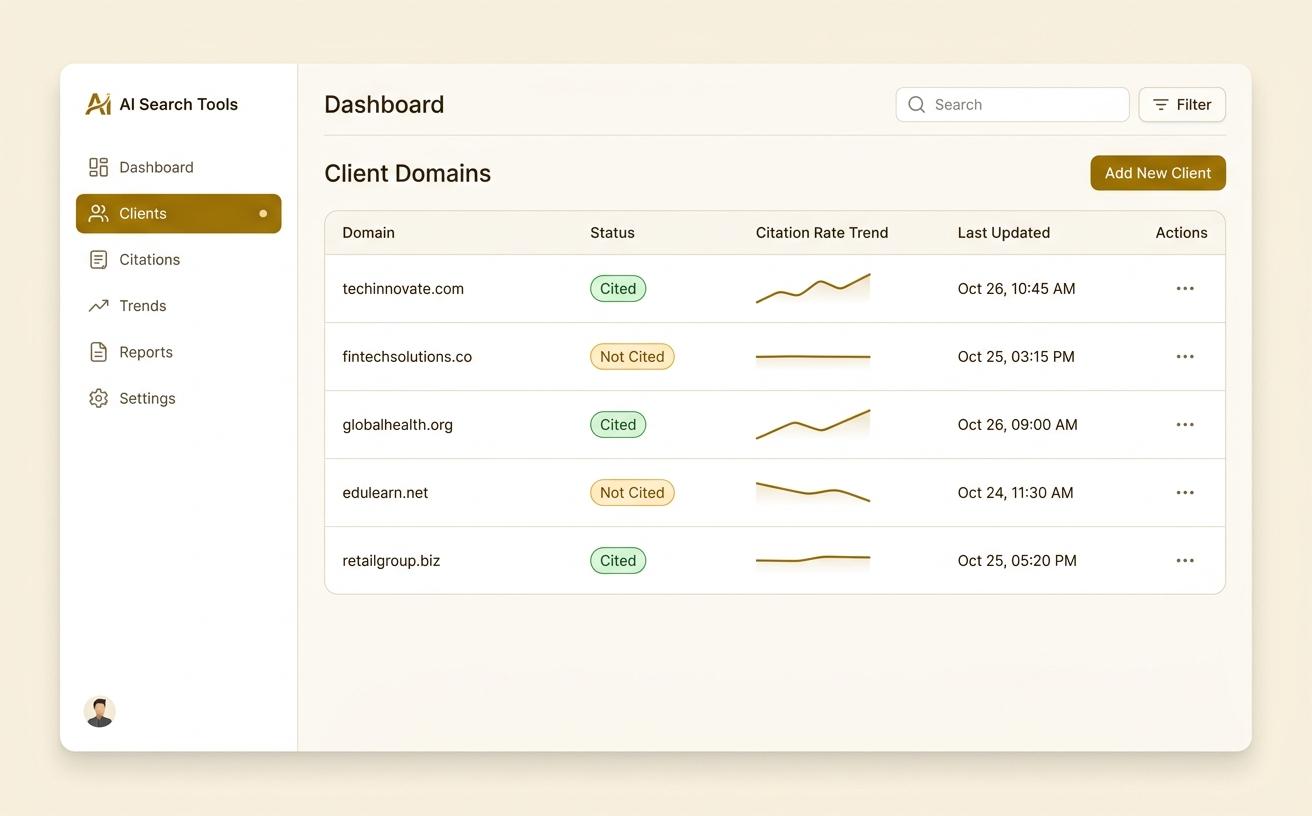
This is the loop that runs on a schedule for every client domain you track.
When someone asks ChatGPT "who's the best AEO tool for agencies," the answer comes from whichever pages ChatGPT decided were worth citing that day. Nobody submitted a form. The citation either happened or it didn't.
An AI visibility tool tracks whether a brand gets cited in AI-generated answers across engines like ChatGPT and Perplexity, then reports where citations are missing so the content can be fixed. Every tool already in the category was built for a single brand watching itself, not an agency watching twelve, and most stop at a citation count. None of them fix it.
Google's AI Overviews now appear in 43% of US searches, up from 15% a year earlier. A domain can rank #1 organically and still get skipped entirely when an AI engine writes its own answer, a separate, unmeasured metric most agency reporting still misses.
Most AI visibility tools were designed for one company watching its own name. This one starts from an agency managing many.
A citation count without a fix is half a product. This one generates the rewrite and re-checks whether it worked.
No per-domain multiplier that punishes an agency for growing from 3 clients to 10.
Every AI visibility tool tracks citations. Here's what determines whether it fits an agency running multiple clients.
Set up a domain and a few prompts once. Scheduled checks log every citation automatically.
One workspace holds every client domain, with per-client history and a rolled-up view.
A "not cited" result generates a rewrite, then re-checks it after you publish.
White-label exports carry your agency's branding, not ours.
Built on official, structured API access. A failed check shows as "delayed," never a fabricated result.
The citation checker and content scorer are free tools, not seven-day trials.
Every competitor in this category stops at diagnosis. A citation check tells an agency what's broken and leaves the fixing to a separate content workflow, a separate brief, a separate writer. This one doesn't.
We're a leading provider of project management solutions designed to help teams of all sizes work smarter. Our platform has been trusted by businesses worldwide for over a decade, and our commitment to customer success is second to none. Whether you're a startup or an enterprise, we have a plan that's right for you.
For teams of 5 to 20 people, the three strongest options are Linear, Height, and Basecamp. Linear suits engineering teams that need issue tracking tied to git branches. Height fits cross-functional teams wanting one view of design and dev work. Basecamp charges a flat rate for unlimited users, which becomes cheapest once a team passes roughly forty seats.
Most tools in this category were built for a single brand watching its own citation status. Add a second client and the pricing multiplies, or the interface starts hiding accounts behind tabs it was never designed for.
A client-facing report showing a vendor's name undercuts the thing an agency is actually selling: its own expertise. Reports export under the agency's branding, with no visible reference to this tool anywhere in the document.
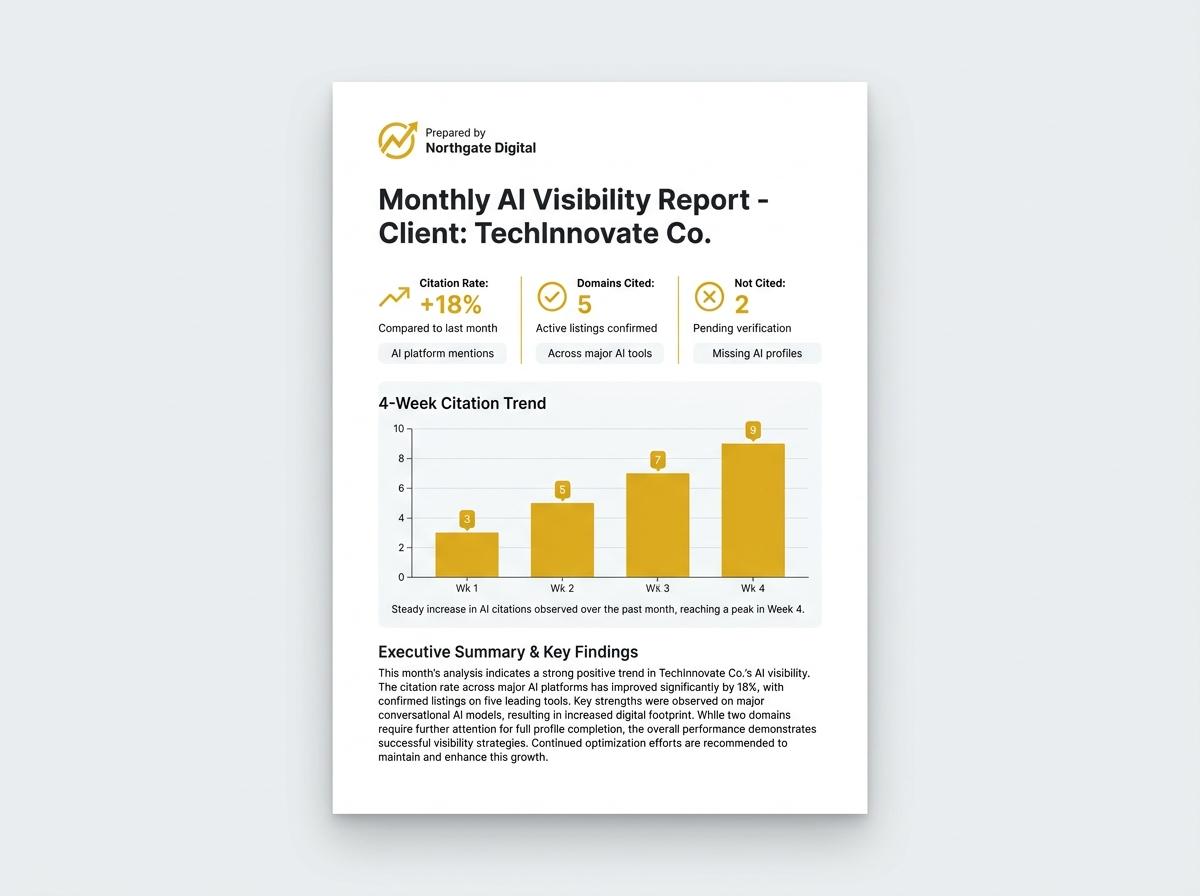
One workspace tracks every client domain without a per-domain price jump. Weekly reporting stops being a manual ChatGPT-and-spreadsheet routine and becomes a scheduled check with a real before-and-after to show. White-label exports mean the client sees your agency's name on the analysis, not a vendor's.
The Starter tier covers a first client or a personal project without paying for nine seats you don't have. The same audit-to-fix loop that works for a 10-client agency works identically at one domain: check, diagnose, rewrite, verify.
Enter the domain and the specific questions a prospect would realistically ask an AI engine.
Prompts run against ChatGPT and Perplexity on a schedule. Every run logs a real cited or not-cited result.
Generate a rewrite, publish it, re-run the check. The dashboard shows before-and-after side by side.
A one-off check on any domain against any query. No account needed.
Try the citation checkerScore any URL or pasted content for AI-citability and get specific fixes.
Try the content optimizerReal starting prices, not a "book a demo" wall. Judge for yourself.
| Tool | Starting price | Agency workspace | Fixes content | Free tier |
|---|---|---|---|---|
| AI Search Tools | $0-$39.99/mo to start | Yes | Yes | Yes |
| Profound | $99/mo entry, $399/mo for 3 engines | No | No | No |
| Ahrefs Brand Radar | From ~$328/mo, add-on plus base plan | No | No | No |
| Semrush AI Visibility Toolkit | ~$99/mo + existing subscription | No | No | No |
| Otterly.ai | $29/mo for 15 prompts, 4 engines | No | No | No |
None of the four competitors above publish a starting price this low. This one does.
$39.99/mo
A freelancer or first client
$99.99/mo
The 3-15 client book
$199.99/mo
Larger client rosters
An AI visibility tool tracks whether a domain or brand gets cited in AI-generated answers from engines like ChatGPT, Perplexity, and Google AI Overviews, then reports which prompts triggered a citation and which didn't. AI Search Tools adds the second half most competitors skip: turning a missing citation into a rewritten, re-checked fix.
Traditional SEO tracks where a page ranks in organic search results. AI visibility tracks whether an AI engine cites that page when generating an answer, which is a separate outcome. A domain can rank #1 organically and still never get quoted by ChatGPT, because the two systems select sources differently.
GEO stands for Generative Engine Optimization, the practice of structuring content so generative AI engines retrieve and cite it when synthesizing an answer. It's the AI-search equivalent of what SEO is for traditional search rankings.
ChatGPT and Perplexity at launch, both through official, structured API access rather than an in-house scraper. Google AI Overviews and Copilot are on the roadmap as fast-follow coverage once the two-engine loop is proven, not scraped-together approximations shipped early.
The free tier is not a time-limited trial. It includes the citation checker and the content optimizer's scoring pass, with no credit card required to start. Paid tiers add scheduled monitoring, the full rewrite tool, and white-label reporting.
Enter a domain and a query on the citation checker page. AI Search Tools runs that query against a tracked AI engine and reports whether the domain was cited in the response, along with the specific URL that got quoted if one did. No signup required for a single check.
Yes, on the Agency+ tier. Reports export with your agency's branding and no visible reference to AI Search Tools, so what your client sees is your analysis under your name.
No. A workspace works the same whether you're tracking client domains or just your own company's. If you're a founder who wants to know whether ChatGPT or Perplexity cite your own site, the Starter tier covers one domain and works identically to how a freelancer would track a single client.
Some cheaper tools scrape AI engine responses through unofficial methods, which breaks quietly the moment a provider changes its interface. A scraped check that fails silently looks identical, from the outside, to a domain that genuinely stopped getting cited, and an agency reporting that false negative to a client burns trust for a problem that never existed. Structured API access doesn't have that failure mode: a check that can't complete shows up as "delayed," not a fabricated "not cited." That distinction came directly out of building the monitoring engine on official API access instead of a scraper.
Start with the free tier. No credit card required, and nobody's going to call you to sell you the paid plan.